Black and White Art Picture All the Nus Thats Firt to Print Jm 602 Art Picture

Vectorized Light
This section of the Projection Light web site contains images that illustrate a variety of visual phenomena. They were created in Adobe Illustrator and so saved for posting as PDFs. These files tin can be downloaded and printed at any scale and still retain the abrupt edges which facilitate the efficacy of about of the effects. All of these phenomena require or gain strength from existence displayed in a large format, say a 1000 (or meter) on a side. If the user has access to a affiche size printer, it is recommended that the figures exist printed at that scale. About the choice of specific images: we take selected ones that exemplify a broad range of visual phenomena. They are based on images originally created by artists, vision scientists – or past people who could, in fact, be called both. The PDFs we have posted are our own variations on these works and are not by the artists themselves. A few references – either by the artists or scientists who created the individual images or that contain discussions about their works – are included below. In each group, hit the "PDF" button tin download a single file containing all the PDFs in that grouping. The push labeled "Zip" will download a folder containing the individual files in that grouping.
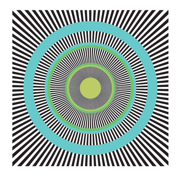 | Isia Leviant'southward "Enigma"The French artist Isa Leviant created the original version - in 1980 - of the figures that we take included. Past placing colored circular "avenues" around arrays of radial lines, he noticed that the avenues appeared to contain "blobs" that sometimes motility clockwise, sometimes counter-clockwise. He chosen the effigy "Enigma". It gives rise to what is now sometimes called the "traffic illusion". He originally called information technology the L (for alive) effect. It does piece of work at pocket-size scale, but nosotros accept produced it for printing on a large scale, say meter size, but as his original prints were done. The cause of the event has given rising to a modest industry of experiments and explanations. We include here the two original references past the creative person. | ||
 |  |  | Leviant, Isia, "Illusory Move Within Still Pictures: The L-Issue", Leonardo, fifteen, No. three, 22-223, 1982. Leviant, I. "Does 'Brain Power' Make Enigma Spin?", Proc. Roy. Soc. Lond B, 263, 997 – 1001,1996. |
| Download PDF | ZIP | |||
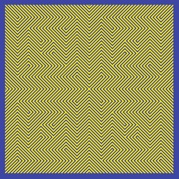 | Reginald Neal's "Foursquare of Two"Our image is based on a lithograph printed on paper called "Square of Two" created by the American artist Reginald H. Neal in 1970. That piece of work was approximately 23 inches on a side and was done with two colors: blue lines on a yellow background. It produces effects sometimes referred to every bit "jazzing" or "flicker". This work was in plow based on an before piece of work past Neal entitled "Square of Three: Xanthous and Blackness" which consisted of an array of 9 squares and was approximately 33 inches on a side. That work was created using lithographic ink and acrylic paint on canvas, which was mounted on Masonite. We accept included versions of "Foursquare of 2" in diverse color combinations to permit observers to explore several visual effects including isoluminence. | ||
 |  |  | Kupin, J. J., Haddad, G.M. and Steinman, R. M., "Saccades in Neal'southward "Square of Three", Perception and Psychophysics, 14, No. 2, 298 – 300, 1973. Reginald Neal: A Retrospective of His Prints, catalogue of an exhibition at The Jane Voorhees Zimmerli Art Museum, Rutgers, the Land University of New Bailiwick of jersey, 1986. Inglis, T. C. and Kaplan, C. S., "Generating Op Fine art Lines", in Computational Aesthetics in Graphics, Visualization and Imaging, 2011. |
| Download PDF | ZIP | |||
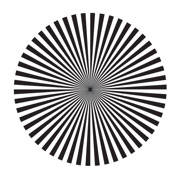 | Donald MacKay's "Rays"In a series of papers published in the journal Nature beginning in 1957, the British vision scientist Donald M. Mackay displayed a number of stationary patterns that in many observers give ascension to the percept of both motion and colour. These simple patterns consisted of linear arrays of parallel lines, as well equally arrays of radial lines, of various numbers and relative line thicknesses. These figures tin can exist quite effective even viewed on a small scale. They gain strength when printed on a large scale and viewed in bright low-cal. We take produced such patterns with a variety of parameters. | ||
 |  |  | Mackay, D. Grand., "Moving Images Produced past regular Stationary Patters, Nature, 180, 849 – 850, 1957. Gregory, R. L., "A Comment: Mackay Rays Shimmer Due to Accommodation Changes", Proc. Roy. Soc. Lond. B, 253, 123, 1993. Note: Some of these effects can be explored on the Project Low-cal web site. |
| Download PDF | ZIP | |||
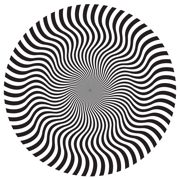 | Nicholas Wade's "Chrysanthemum"Nicholas Wade is a vision scientist at the Academy of Dundee in Scotland. He has carried out psychophysical enquiry on many visual phenomena and has written extensively on the history of the neurosciences. He is besides an achieved artist. The effigy we accept included here is a vectorized version we created in Adobe Illustrator based on i of the art works that Wade himself drew by mitt. Information technology is included hither because information technology elicits a feeling of depth in many observers. Viewed by closing one eye, or monocularly through a tube, or using a device called a "synopter" that allows for viewing the same paradigm with both eyes (without disparity) the image gains even more than in depth. | ||
 |  |  | Wade, Northward., The Art and Science of Visual Illusions, (Routledge & Kegan Paul, London), 1982. Wade, North., Visual Allusions: Picture of Perception, (50. Erlbaum Associates, London), 1990. |
| Download PDF | Naught | |||
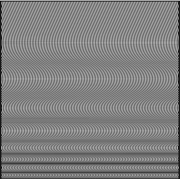 | Bridget Riley'south "Fall"The painting "Fall" by the British artist Bridget Riley is one of the iconic images of the "Op Fine art" movement of the 1960's. It is in the Tate Gallery in London. Painted in black and white, it is quite big, measuring approximately 56 inches on a side. For many viewers, it has a disorienting outcome giving rise to percepts of both depth and motility. At that place is a big literature of the possible causes of these effects. Ii recent articles that include many references to the literature are included here. | ||
| van Tonder, One thousand. J., "Perceptual Disruption and Composure in Bridget Riley'southward Zanker, J. M., Hermens, F. and Walker, R., "Quantifying and Modeling the Strength of Motion Illusions Perceived in Static Patterns", Journal of Vision, ten, No. ii, 1 – 14, 2010. | |||
| Download PDF | |||
 | Marcel Duchamp's "Fluttering Heart"The image presented here is based on 1 created past the artist Marcel Duchamp. Between 1936 and 1961, he produced several versions of what he called "Coeur Volant" as silkscreen prints on paper. That prototype was, in turn, based on ideas discussed by Herman von Helmholtz in his book on physiological eyes. He noted that past placing a red paradigm of a smaller size on a background of blue – or vice versa – and by moving the image laterally in front of an observer, the smaller image would announced to "slip" with respect to the larger. The red and blue have to be quite saturated and, for the strongest event, widely separated in color space. Nether the right circumstances, an credible "detachment" or "jittering" of the figures can be seen simply past gazing at the static image. Marcel Duchamp made peculiarly effective versions of the effect. | ||
 |  |  | Duchamp, 1000., Embrace, Cahiers D'Fine art, 1936. Von Helmholtz, H., Treatise on Physiological Eyes (Dover, New York), 1962. English language translation by J. P. C. Southall for the Optical Society of America from the 3rd German edition of Handbuch der Physiologischen Optik, (Voss, Hamburg), 1910. Nguyen-Tri, D. and Faubert, J, "The Fluttering Heart Illusion: A New Hypothesis", Perception, 32, 627 – 634, 2003. Notation: An interactive version of the Fluttering Heart effect can be explored on the Projection LITE web site. |
| Download PDF | Null | |||
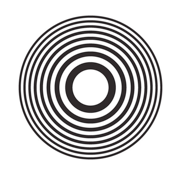 | Agustin-Jean Fresnel's "Zone Plate"The images included hither are of the pattern called a Fresnel "zone plate". The figure consists of alternating black and white rings of (roughly) equal areas. The configuration was originally devised by the French physicist Augustin-Jean Fresnel around 1819. Information technology finds its main application in photography and imaging. Reduced in size with alternating opaque and transparent regions, information technology can be used in identify of a lens or pinhole to produce quite intriguing photographic images. It is included because of its novel appearance and because in the large format presented here, it can requite ascent to the percept of subjective colors in many observers, mainly betwixt the outer rings. | ||
 |  |  | Fresnel, A., "Memoir on the Diffraction of Calorie-free", in The Wave Theory of Low-cal – Memoirs by Huygens, Young and Fresnel, (American Book Visitor, New York), 79 – 145, 1900. |
| Download PDF | ZIP | |||
 | Linear Grid Line PatternsWe accept included several images consisting of parallel direct lines. This is the simplest arrangement of lines that gives rise to and then-chosen "subjective" colors. British scientist David Brewster outset reported the upshot in 1825. The result has been "re-discovered" many times since. Printed on any scale and viewed from the appropriate distance, many observers report the appearance of regions of de-saturated colors. This static pattern tin exist viewed either with a vertical or horizontal orientation or rotated by 45 degrees to the vertical. The origin of the colors perceived in both stationary and moving black and white patters is still open to debate. | ||
 |  |  | Brewster, D., "On Some Remarkable Affections of the Retina, As Exhibited in its Intensity to Indirect Impressions, and to the Impressions of Attenuated Light", Edin. J. Sci., 3, 288 – 293, 1825. Erb, Thou. B. and Dallenbach, K. M. "'Subjective' Colors from Line Patterns", Amer. J. Psychol., 52, 227 – 241, 1939. |
| Download PDF | ZIP 36" 10 72" | |||
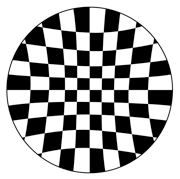 | Hermann Helmholtz' Hyperbolic CheckerboardThe images contained here are based on the patterns showtime discussed by the 19th century polymath Hermann von Helmholtz in his not bad work on physiological optics. In it, he included a pocket-size image of a checkerboard pattern with the lines distorted – nigh noticeably in the periphery - to form a kind of hyperbolic checkerboard. In the original volume, the image is likewise small to actually use equally a test target. However, he noted that if it were enlarged and viewed from a suitable altitude that the lines in the periphery would appear to "straighten out". Expanded to 36 inches on a side and viewed from a altitude of about 18 inches, the effect is quite striking. The percept suggests that there is a circuitous mapping of physical infinite to visual infinite, specially in the peripheral parts of the visual field. We take included an image of a regular checkerboard as well. This figure, on the other paw, does non appear to get curved with most viewing. However, while budgeted information technology rapidly, the regular checkerboard does appear to bow out and await convex. | |
 |  | von Helmholtz, H., Treatise on Physiological Optics (Dover, New York), 1962. English translation by J. P. C. Southall for the Optical Society of America from the tertiary German edition of Handbuch der Physiologischen Optik, (Voss, Hamburg), 1910. Rogers, B. and Brecher, K. "Straight Lines, 'Uncurved Lines' and Helmholtz'south 'Great Circles on the Celestial Sphere'", Perception, 36, 1275 -1289, 2007. |
| Download PDF | Nil | ||
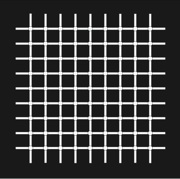 | "Scintillating Filigree" EffectThe "scintillating grid" illusion is a recent variation of the "Hermann Grid" illusion that was originally reported by Ludimar Hermann in 1879. In both cases, viewers written report seeing the appearance of "blobs" at the intersections of the avenues cutting through the background field. If 1 stares at a given dot, information technology usually disappears, though the ones in the periphery remain. This effect works on any scale, but is particularly effective with a large epitome. | |
 |  | Schrauf, Grand., Lingelbach, R. and Wist, Eastward. R., "The Scintillating Grid Illusion", Vision Research, 37, No. eight, 1033 – 1038, 1997. Note: Controllable versions of this effect tin can be explored on the Projection LITE web site. |
| Download PDF | ZIP | ||
 | Based on the Ouchi IllusionThe image presented hither is a variation of the i that appeared in a book by the Japanese artist Hajime Ouchi. The book independent "746 designs for artists and craftsman". Motion of the observer, or of the image, gives rise to the appearance of a slippage of the cardinal region with respect to the environment. A wide multifariousness of experimental and theoretical studies of this image have been carried out in the brusque fourth dimension since its construction. Ouchi, H., Japanese Optical and Geometrical Art, 75, (Dover, New York), 1977.Fermuller, C., Pless, R., Aloimonos, Y., "The Ouchi Illusion equally an Artefact of Biased Menstruum Information", Vision Res., twoscore, 77 – 96, 2000. |
| Download PDF | |
Miscellaneous Images | ||
| We include here three other images that give rise to novel percepts in most observers. The black and white circular prototype on the left is based on several paintings and graphics past Italian artist Marina Apollonio. This two dimensional picture produces a strong impression of depth. The cherry-red and blueish figure is based on the 1966 screen print "Looking Glass No. iii" by British artist Peter Sedgley. In this case the blurring of the edges of the circle combines with the cherry/blue dissimilarity of colors in the image to arrive difficult to get a firm visual grip on the cardinal circumvolve. The terminal image is called "Fluttering Rays" and was designed by the French/American artist Rrose Sélavy. | ||
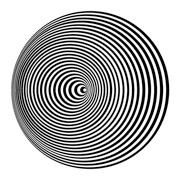 |  | 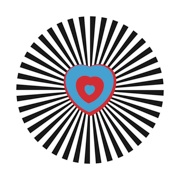 |
| Marina Apollonio | Peter Sedgley | Rrose Sélavy |
| Download PDF | Download PDF | Download PDF |
The PDFs included here are by Kenneth Brecher and Rebecca Puno.
Project LITE is supported by NSF Grant # DUE-0715975.
© 2012 Trustees of Boston University.
Project Light Home
Source: https://www.bu.edu/lite/Project_LITE_Vector/Vectorized_LITE.html
0 Response to "Black and White Art Picture All the Nus Thats Firt to Print Jm 602 Art Picture"
Post a Comment