Penn Medicine CHIME tool predicts Philly hospital surges due to Covid-19
Modeling The Pandemic
Penn Medicine and Lawmaking for Philly have adult a tool that predicts local hospital surges due to Covid-19. Its ultimate accuracy depends on yous
Apr. 13, 2020


 Weather forecasting has saved endless lives over the years, and in Philadelphia meteorologists have taken on an almost mythic status at times, condign local celebrities. (Thanks, John Bolaris.)
Now at that place is a new crew on the scene trying to untangle what lies in our future—simply they don't stand in front of dark-green screens or tell you when to bring an umbrella.
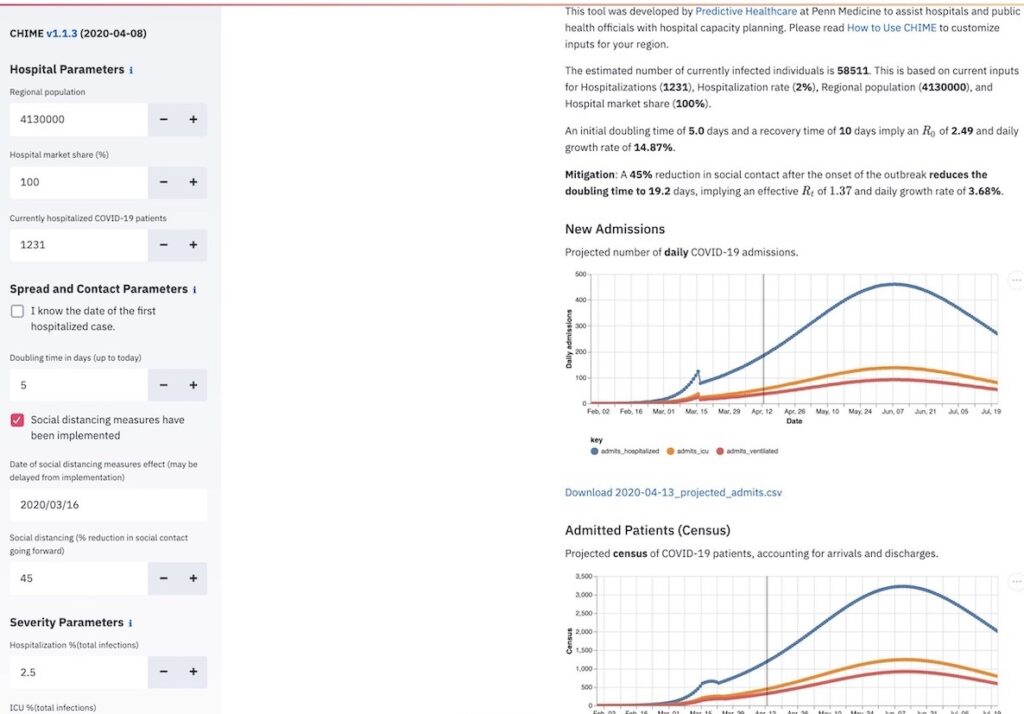
The Predictive Health Care Team at Penn Medicine has built a tool to estimate when Covid-19 hospitalizations volition peak, which should help infirmary staff plan and gear up. The team's model, Covid-nineteen Infirmary Impact Model for Epidemics, or Chime, now predicts a mid-May surge in the Philadelphia region that could overwhelm hospital chapters.
That's a flake of a contrast with the more highly cited Covid-xix model, developed by the Found for Health Metrics and Evaluation at the Academy of Washington.
The IHME model predicts the infections throughout Pennsylvania to peak today, and suggests the state'south hospitals have enough beds to see the need.
"This is one of a number of publicly bachelor tools for modeling hospital utilization scenarios, each of which can play an of import role in helping leaders evaluate and programme for deployment of resources," Dr. C William Hanson III, the chief medical information officer of Penn Medicine said in a argument. "The purpose of this modeling is not to make predictions with certainty, but instead to provide a range of scenarios which can assist with planning and besides demonstrate the upshot mitigation efforts like social distancing tin accept on slowing the spread of the virus."
The CHIME model was developed in-house at the premier research establishment, but it has received a lot of assistance from Philadelphia's computer programming community, which has helped the online model run faster with more user-friendly features.
Penn Medicine's Predictive Health Care Team'south modeling now predicts a mid-May surge in the Philadelphia region that could overwhelm hospital capacity.
The Penn Medicine team had just finished a projection with Lawmaking for Philly to better inform doctors well-nigh where they could send patients for medically-assisted treatment of opioid-use disorder.
Michael Becker, a senior data scientist at the Penn Medicine squad, got in impact with Code for Philly to aid on the new project, working on the biggest public health crisis the planet has seen in a century.
"Fifty-fifty though we're a big city, information technology feels like everybody knows everybody, which is how this happened," says Marieke Jackson, co-director of Code for Philly, which is an all-volunteer grouping. "The response of people who only want to help and do what they tin is incredible."
The volunteer work on the Chinkle calculator lawmaking has benefitted from the slowdown in almost normal business concern activeness, according to Chris Alfano, who helped organize the Lawmaking for Philly response.
 "Anybody was suddenly habitation and having trouble working. So we just had this influx of very highly skilled people with a lot of costless time on their easily—kinda how we always imagined it where nosotros just write downwards on the board a bunch of issues and and so strangers merely prove up and know what they're doing, and fix them on the spot," says Alfano.
Linode, a Philadelphia visitor, took over the responsibility of hosting the site for free, according to Alfano. (Alfano's company, Jarvus Innovations, has likewise washed some work for The Citizen)
Programmers are working on another iteration of the Chinkle site that will have a new look, according to Alfano, who said there has been some discussion nigh spinoff projects to look at capacity planning for personal protective equipment.
The utility of the Chime model is its adaptability. Information technology looks a trivial clunkier than the IHME, but with merely a few data inputs it can make a prediction about the number of people who volition be infected, the number hospitalized, and the number in intensive treat any geographic area or hospital catchment at a given time.
Jackson, who has a primary's in epidemiology from New Mexico Country University and a full-time job at Health Union, said Chinkle uses a "relatively established epidemiological model," which tin speedily spit out results.
Similar other models, CHIME creates a bell bend. The worse the conditions are, the taller and thinner the bell.
On its website, Chime credits Michael Levy, a professor at the Perelman School of Medicine, for his assistance reviewing the model assumptions, and it besides acknowledges Dr. James Lawler, a professor at the Academy of Nebraska Medical Center, for a tardily-Feb webinar about preparing for Covid.
The IHME is easier to use than Chinkle, only more express. The user tin apace pull up the predictions for each land, learning not but about the numbers, but also the specific policies—such every bit stay-at-dwelling house orders that have been put in place.
But state borders aren't e'er the best geographic demarcation, especially when dealing with a highly communicable diseases.
Philadelphia is located at the southeastern edge of a state that is more 300 times its size, and Philly has many more connections with parts of New Jersey and Delaware than it does much of Pennsylvania.
Philadelphia Mayor Jim Kenney illustrated this dynamic at a recent press conference, when he said that his mother lives in Jersey, just if she needed to go to a hospital she would go to Jefferson in Philly.
Penn'south CHIME model was developed in-house, merely information technology has received a lot of assistance from Philadelphia'due south computer programming community, which has helped the online model run faster with more than convenient features.
Officials at the Pennsylvania Department of Health have been consulting the Chinkle model, along with one developed past the University of Pittsburgh, and the University of Washington tool, amidst others.
Vice President Mike Pence said last calendar week that officials are seeing signals that may betoken a forthcoming surge in Philadelphia, and maybe Pittsburgh also.
At Metropolis Hall, Wellness Commissioner Dr. Thomas Farley sounds more focused on avoiding any bad outcomes than predicting when the local wellness care system volition be under the greatest strain.
"In that location's tremendous uncertainty to these models. They predict very different peaks, and different timings of those peaks. We need to be prepared for all of those," Farley said at a contempo press conference. "If nosotros are really successful, nosotros won't see much of a wave. If nosotros are not successful, nosotros could run into a wave that would exceed our hospital capacity."
But by securing space to treat 200 or more patients at Temple University's Liacouras Center and trying just declining to utilise Hahnemann Hospital, city officials have made it articulate that they see storm clouds on the horizon, and are making preparations for things to get worse.
Epidemiological predictions are not new, only they have never been attempted at this calibration because there has never been a virus outbreak quite like this—at least since the 1918 influenza pandemic.
Whereas weather forecasting uses difficult metrics similar barometric pressure and h2o temperature, measuring the possible scale and intensity of the Covid-19 outbreak depends in large role on human behavior.
Pretty much anybody has a role to play in determining how many people become sick. In that manner, modeling a pandemic may be more akin to making economic forecasts or stock market predictions than charting the likely path of a hurricane.
And of course Chime might not prove authentic. The Chime  developers themselves identify a big caution atop their webpage alarm that in that location is a "high degree of doubt almost the details of Covid-xix infection, transmission and the effectiveness of social distancing measures."
The IHME recently adjusted its model to predict 81,766 people in the U.s.a. will die of Covid-xix through early August, down from 93,531 simply a few days before.
While the science is inexact, it is helpful to have multiple epidemiological studies and models to compare against each other, co-ordinate to Jackson. Once more data becomes available, more than complex models can exist congenital.
Although CHIME was congenital with hospital and public health officials in mind, anyone with enough knowledge can plug in information to become a hint most how bad it will get, and when things might first getting better.
There is one variable, however, that yous won't discover with whatsoever precision during the daily briefings on confirmed cases and hospitalizations: the data for the reduction in physical contact going forward, which has enormous bearing on the CHIME forecast.
The CHIME team, who were unavailable for comment, addressed how policies and behaviors to reduce contact could interpret into numbers in a blog post, merely as well acknowledged they fabricated an "educated guess."
Equally with so many things in life, we are the ultimate wildcard. We the people, collectively, can help determine if the models were overly pessimistic or not.
Photo courtesy Ryan Chiliad. Breeden / Navy Medicine / Flickr 
Source: https://thephiladelphiacitizen.org/chime-covid-philly-predictions/
0 Response to "Penn Medicine CHIME tool predicts Philly hospital surges due to Covid-19"
Post a Comment