A Great Awakening for history and social studies
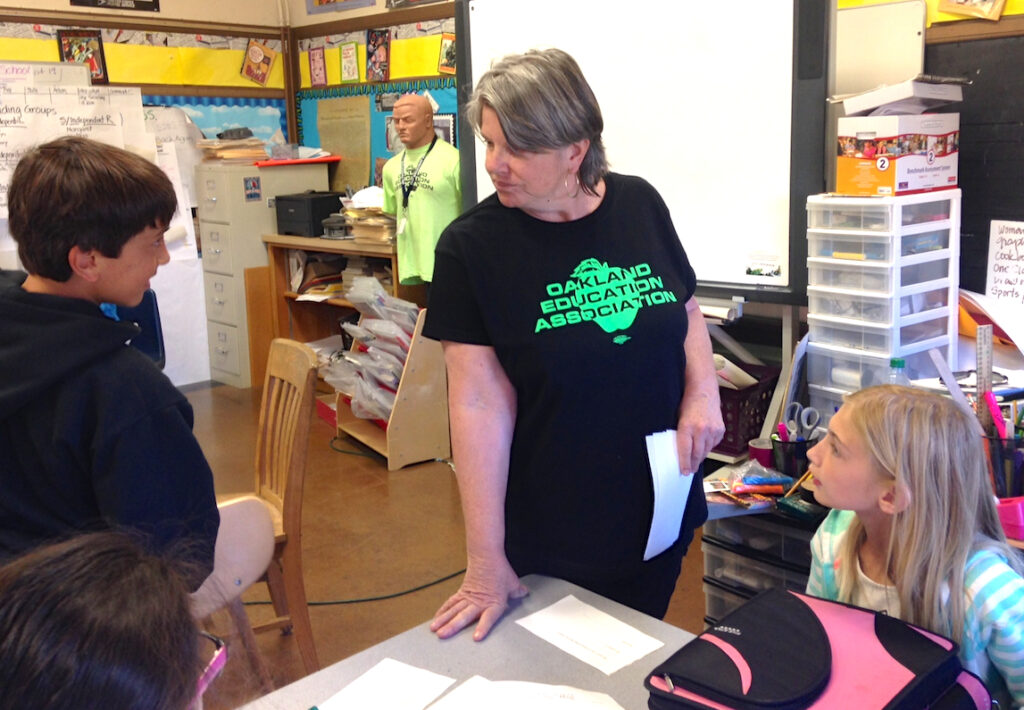 Credit: John Fensterwald/EdSource Today
Oakland Unified history instructor Jennifer Brouhard discusses perceptions of women at work in the Richmond shipyards with fifth graders Luca Paz and Helenna Rekic.
Update: This story was updated June 4 with information on the timeline for revising the history and social studies frameworks.
For history and social studies teachers in California, the Mutual Core State Standards are welcome allies in their struggle to liberate their bailiwick from a decade of inattention and irrelevance.
They are encouraged that the new standards stress the importance of research and belittling skills and elevate the importance of historical documents in reading comprehension. They feel valued as colleagues once once again.
"Common Core gives the states permission to finally teach history and non pretend it is some other English class," said Andrew Pegan, an eightth-grade history teacher in the Compton Unified School District. "That's why I honey Mutual Core."
"I feel like we are emerging from the Dark Ages of educational policy," said Ruth Moore, an 8th-grade history and English teacher at Santa Rosa Middle Schoolhouse.
Pegan was an instructor for and Moore was attending this year'southward conference of the California Council for Social Studies in Oakland, where sessions like Pegan's "Critical History: Making History Relevant in a Common Cadre Earth" were prominent in the three-day program. Social studies and history teachers say they are encouraged that the creators of the Common Core, a fix of English language language arts and math standards that California and 42 other states take adopted, weave liberal doses of history and science into the standards' approach to literacy and numeracy.

Credit: John Fensterwald/EdSource Today
Andrew Pegan, an eighth-class history instructor in Compton Unified, says the Mutual Core has freed him to teach history as it should be taught.
They add that what distinguishes the Mutual Core from previous standards is the emphasis on the skills that constructive history teachers take taught their students when they take had the hazard. These include nonfiction writing, citing evidence and making arguments, and comprehending "complex texts" to prepare students for life later on high school.
"These are large changes in didactics, but social studies teachers are non seeing annihilation new," said Martha Infante, a middle schoolhouse history teacher in Los Angeles Unified and incoming president of the Quango for Social Studies.
Infante and others add that the Academic Operation Alphabetize and the federal No Kid Left Behind law squeezed history out of the curriculum in most districts during the past decade. They say that limited teachers' ability to teach history the right way – and share its excitement.
Both history and science wasn't a priority in the country and federal school accountability systems. Instead, results on the state math and English language linguistic communication arts tests were used to judge – and often punish – schools and districts. Knowledge of history was first tested in 8th course. The common refrain – what gets tested gets taught – proved true. Both history and scientific discipline, Infante and others complained, weren't taught, especially in uncomplicated grades.
"Students arriving in middle school lacked civics and history knowledge," Infante said. "I never saw anything similar that when I started educational activity in the '90s."
"In that location has been a marginalization of social studies for quite a few years," said Nancy McTygue, executive director of the California History-Social Science Project, a statewide network of history scholars and Yard-12 teachers offer training in history and social science. Students not only didn't get content knowledge, she said, they weren't exposed to nonfiction texts.
She institute it puzzling and frustrating. "Why on globe would school leaders reduce instructional fourth dimension for history, a text-dependent subject area, if they wanted to improve student literacy?" she asks in the introduction to "Teaching the Common Core," a publication of the state history project.
Pegan said middle and loftier school history teachers found they had to do "History 101," going over the basics of what students had missed. "I tried to do the history of Thanksgiving, merely (students) had never even been given the fairy-tale version," he said.
The old land English language arts standards' focus on literature and fiction affected how history was taught beyond simple school, Pegan said. "History became English Function Ii. History teachers were asked to teach history with standards that were meant for literature," he said, substituting historical fiction for the utilise of original historical sources.

Credit: John Fensterwald/EdSource Today
A chart in Jennifer Brouhard's fifth-grade history class at Glenview Elementary in Oakland.
The Mutual Core has changed how reading and writing will exist taught. The English language arts standards for grades 6 to 12 feature separate sections for using history/social studies and science topics and materials to develop reading comprehension and writing skills. An appendix features examples of how to integrate historical topics and documents, such as Lincoln's Gettysburg Address, in English classes. The history/social studies sections lay out ways, past grade, to analyze texts, use master sources and develop arguments and points of view. Sample questions on the new Smarter Balanced exam in the new standards include readings from history.
The Mutual Core more than explicitly defines literacy as a shared responsibility. History and social studies teachers are welcoming this plow of events. "Hearing the new dialogue resonates with me. I sleep more than peacefully at night," said Moore, the Santa Rosa Middle School instructor.
The Common Core standards as well tin can suspension downward classroom walls and encourage English and history/social science teachers to work together. For the first time, Infante said, teachers in other disciplines are seeing through a social studies lens and collaborating. The connections, she said, brand sense.

A poster featuring Rosie the Riveter, a cultural icon celebrating women who worked in factories and shipyards during World State of war Ii. The adult female most identified with Rosie, Rose Will Monroe, actually worked in an plane factory in Michigan, not at the shipyards in Richmond.
Last yr, Infante said, she and an English teacher collaborated on an assignment that asked students to write a persuasive essay on whether John Brown was justified in leading a slave rebellion. In the English class, students read master source documents: John Brown'south accost to the courtroom virtually to sentence him in 1859 and Colonel Robert Due east. Lee'due south "Written report Apropos the Attack at Harper's Ferry." In her form, they explored the causes and ramifications of the rebellion in depth. Students received credit for the essay in both classes.
Another class, taught by Jennifer Brouhard at Glenview Elementary Schoolhouse in Oakland, offered a glimpse of history thriving.Students were collaborating in small-scale groups, using historical documents and gaining an intuitive agreement of life in earlier times.
On a recent morning, the 35 students in Brouhard'southward combination 4thursday-5th grade class, one of three history classes she teaches each day, were studying slides of women at piece of work in the Richmond Shipyards during World War Ii. It's office of a year-long theme on economic forces that shaped America that Brouhard, who'south been teaching for 19 years, chose.
"What do you notice?" Brouhard asked well-nigh the first slide, the famous affiche of Rosie the Riveter flexing her bicep below the words, "We Can Practise It!" Brohard asked students at each tabular array to talk information technology over and ship a representative to the front to share thoughts.

Credit: John Fensterwald/EdSource Today
At Brouhard's request, Blanca Cuartas and her classmates practice the Rosie the Riveter pose.
"It shows she can practise whatever men can do," said 4thursday-grader Zachary Smith.
"How can you support your claim that men and women tin do information technology?" Brouhard asked. A male child used a laser pointer to signal to her biceps.
Brouhard, who does picayune lecturing during the two-hour grade, explained that World War Two was the showtime time that large numbers of women entered the workforce. African-Americans came to Richmond for the shipyards, as well. Workers were employed in shifts to keep the shipyards running 24 hours a twenty-four hours; some lived in their cars, since at that place weren't enough houses.
There was a photo of a woman welder, smile. How come up?
"Mayhap to get more than workers to come," suggested fiveth-grader Fiona Connelly. "Expect how fun this work is. You lot tin get money. Then they can build ships faster and win the war."
"This is what historians do," Brouhard told the form. "We start looking at these photos, primary sources, read oral histories and texts, then form your ain ideas virtually this. Now you lot are getting some ideas – not plenty yet."
The adjacent twenty-four hour period, Brouhard said, she would ask the students to accept all of their observations, with keywords, and write a short essay, making a argument with supporting evidence. She might use the slides every bit a lesson in multiple perspectives, suggesting different ways to interpret the photographer'south message.
"Students come up in as 4th-graders asking, 'What is the right respond?' Nosotros haven't built in thinking in younger grades," she said. "We desire them to ask, 'What are these jobs? What practice shipyards practise, and why are they important?'"
At odds with country history standards
Teaching at Glenview, which allots history equal time with English language, enabled Brouhard to escape the minimization of history that has occurred elsewhere and to teach in means that the Common Core encourages. But such situations are rare in uncomplicated schools, as is the type of collaboration that Infante shared in her school, she said. Many history/social studies teachers, while feeling validated by the new English language arts standards, also feel frustrated past the volume of history content they must get through each twelvemonth.
The Common Core doesn't dictate the content that history/social studies teachers should teach; California'due south own history standards practice that. Adopted in 1998 – before Sept. 11, the Iraq war and the election of President Barack Obama – they are outdated.
The state standards require covering more historical events, facts and details than nigh teachers desire to cover (and most students care to memorize). They also are out of sync with the shift toward education reasoning skills over memorization emphasized in the Common Core social studies standards and the C3 Framework, a document published by the National Council for the Social Studies that provides guidance for state standards in history and civics.
California tried to bridge the gap in 2009 when it began updating the state History-Social Studies Frameworks, the extensive grade-by-grade curriculum guide for instruction the state standards. Simply the Legislature, looking for every penny to save during the recession, froze all funding for curriculum development and textbook adoption.
Six years afterwards, the about completed document needs to be revised once more, to reverberate the Mutual Core social studies standards and to encourage a more than engaging arroyo to civics education, said Tom Adams, the director of the state Department of Education'southward curriculum frameworks and instructional resources division. Adams is hoping funding for the history frameworks volition announced in the May revision to the state budget to pay for experts to sort through the 700 comments and recommendations that the department has received on the frameworks. (Update: Gov. Dark-brown's May budget includes $120,000 to rent history scholars to evaluate the voluminous public annotate and submit their recommendations to the Instructional Quality Commission, which oversees bookish standards piece of work for the State Board of Education. Committee Chair Bill Honig reports that framework is on track for a May 2022 adoption by the State Board. The timeline for the work can exist found here.)
Meanwhile, that leaves history teachers with 2 masters. The Common Core and the draft history frameworks stress exploring topics in depth, while the existing country history and social studies standards require covering a latitude of topics. Pondering the seemingly unanswerable, Moore asked at the history conference in Oakland, "So how do you reconcile the focus on the Mutual Cadre with the reality nosotros have to deal with?"
To get more reports like this one, click hither to sign up for EdSource's no-toll daily email on latest developments in education.
Source: https://edsource.org/2015/a-great-awakening-for-history-and-social-studies/77748
0 Response to "A Great Awakening for history and social studies"
Post a Comment